Overview
Khmer culture is one of the most important yet often overlooked cultural layers in southern Vietnam.
While many travelers associate the region with river life and agriculture in the Mekong Delta, there is another story quietly present across provinces such as Tra Vinh and Soc Trang. This story is shaped by the Khmer community, whose traditions, beliefs, and way of life have existed in the region for centuries.
Understanding Khmer culture adds depth to any journey through southern Vietnam. It reveals a different perspective on history, identity, and daily life that cannot be seen through landscapes alone.
A community rooted in the Mekong Delta
The Khmer people are one of Vietnam’s largest ethnic minority groups, with a strong presence in the Mekong Delta.
Unlike communities that migrated more recently, the Khmer have long been connected to this region. Their villages, traditions, and cultural practices are deeply tied to the land and water systems that define the south.
In provinces like Tra Vinh and Soc Trang, Khmer communities live alongside Kinh and Chinese populations, creating a multicultural environment where different traditions coexist.
This coexistence is not always visible at first glance, but it becomes clearer as you explore local life.
The importance of Theravada Buddhism
Religion plays a central role in Khmer culture.
Most Khmer people follow Theravada Buddhism, which differs in practice and expression from the Mahayana Buddhism more commonly seen in other parts of Vietnam.
Temples are not only places of worship. They are also centers of community life, education, and cultural preservation.
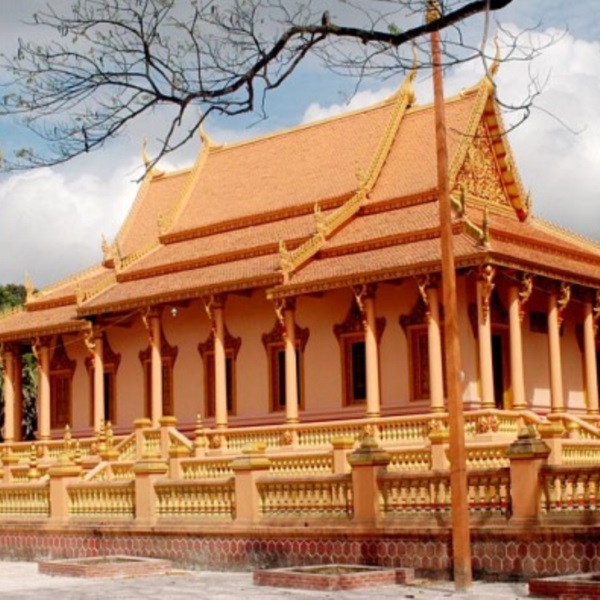
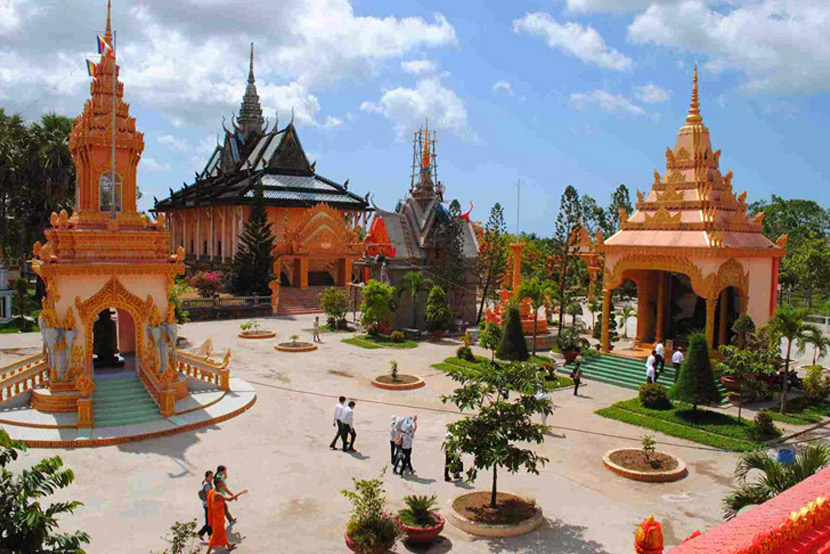
One example is Ang Pagoda, a Khmer temple known for its distinct architecture and peaceful environment. The design, with its golden details and layered roofs, reflects influences from Cambodian temple styles.
For visitors, these temples offer more than visual beauty. They provide insight into how religion shapes daily routines and values within the Khmer community.
Architecture that reflects identity
Khmer temples are among the most recognizable expressions of the culture.
Unlike the pagodas found in other parts of Vietnam, Khmer temples are often brightly colored, richly decorated, and surrounded by open space.
The structures feature curved roofs, detailed carvings, and symbolic elements that represent religious beliefs.
Walking through these spaces feels different from visiting other religious sites. The atmosphere is calm, but the visual details are vibrant.
This architectural style is not only aesthetic. It reflects a cultural identity that has remained strong over time.
Festivals and cultural celebrations
Khmer culture is also expressed through festivals.
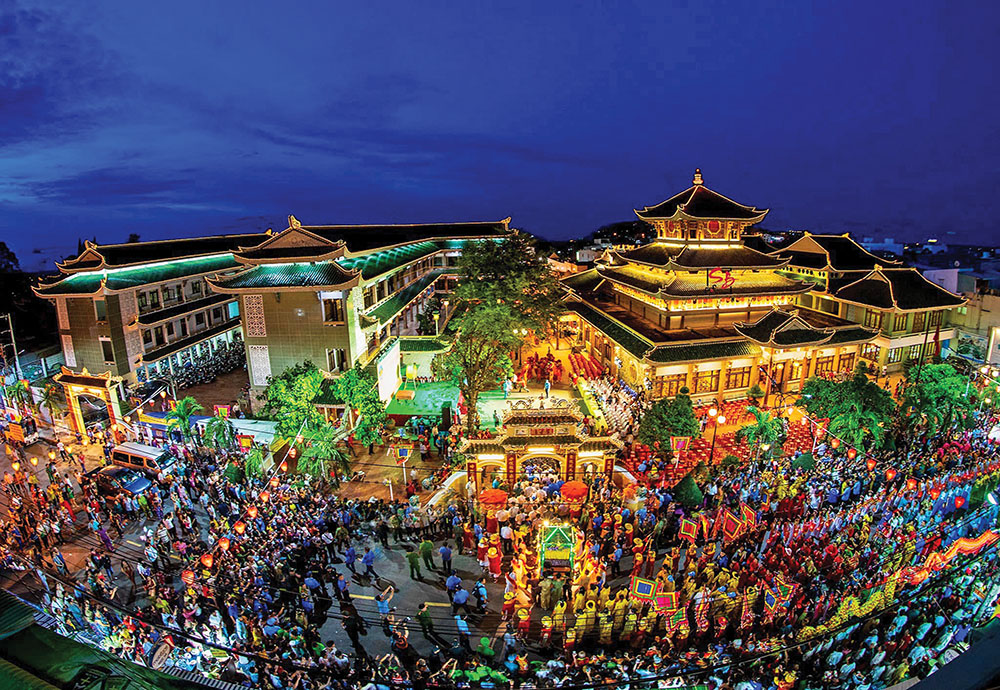
One of the most important is Chol Chnam Thmay, the Khmer New Year, which usually takes place in April. During this time, communities gather at temples, participate in traditional games, and celebrate together.
Another significant festival is Ok Om Bok, often associated with the moon and agricultural cycles. It includes rituals, offerings, and events such as boat racing in certain areas.
These festivals are not designed for tourism. They are deeply rooted in community life.
For travelers who happen to experience them, they offer a rare opportunity to witness traditions that continue to be practiced authentically.
Language and daily life
Language is another important aspect of Khmer culture.
Many Khmer people speak both Khmer and Vietnamese, switching between languages depending on context.
In daily life, traditional customs are often preserved within families and communities. This includes food preparation, social behavior, and religious practices.
For visitors, these details may not always be obvious, but they contribute to the overall cultural landscape of the region.
Food and local traditions
Khmer cuisine in southern Vietnam shares similarities with Cambodian food but also reflects local influences.
Dishes often use fresh herbs, coconut, and fish, similar to other parts of the Mekong Delta. However, preparation methods and flavor combinations can differ.
Food is closely connected to festivals and religious practices. Certain dishes are prepared during specific times of the year, adding cultural meaning to meals.
Exploring local markets and small eateries in Khmer communities provides a more authentic view of this culinary tradition.
A quieter cultural experience
One of the reasons Khmer culture is less visible to many travelers is that it is not always highlighted in mainstream tourism.
Unlike major attractions, Khmer cultural sites are often located in quieter areas, away from typical travel routes.
This creates a different kind of experience.
Instead of large crowds or structured tours, visitors encounter everyday life, local communities, and spaces that feel more personal.
For those interested in culture, this can be one of the most meaningful aspects of traveling in southern Vietnam.
The balance between preservation and change
Like many traditional cultures, Khmer communities are experiencing change.
Modern influences, economic development, and migration all affect how traditions are maintained.
However, many aspects of Khmer culture remain strong, particularly those connected to religion, festivals, and community life.
This balance between preservation and adaptation creates a dynamic cultural environment.
It shows how traditions can continue while still evolving.
Why understanding Khmer culture matters
For travelers, learning about Khmer culture adds another layer to the experience of southern Vietnam.
It moves beyond landscapes and into the lives of people who shape the region.
Understanding these cultural elements helps create a more complete picture of Vietnam as a diverse and multicultural country.
It also encourages a more respectful and thoughtful approach to travel.
Final thoughts on Khmer culture in southern Vietnam
Khmer culture in southern Vietnam is not something you simply visit.
It is something you gradually notice, understand, and appreciate over time.
From temples and festivals to language and daily routines, each element reflects a history that continues to exist in the present.
For travelers willing to look beyond the obvious, this cultural layer offers one of the most meaningful insights into the Mekong Delta.
And in many ways, it reminds you that Vietnam is not defined by a single identity, but by the richness of the communities that live within it.
Itinerary
Price & Bookings
Reservations
Reviews
Share your thoughts with other customers.