
Vietnam stretches more than 1,600 kilometers from north to south, and that length is exactly why “what’s the weather like in Vietnam?” doesn’t have a single answer. On any given day in January, Ha Noi can be gray and chilly while Ho Chi Minh City sits comfortably in the low 30s Celsius under clear skies. Planning a trip around Vietnam’s weather means planning around three distinct climate zones, not one national forecast.
This guide breaks the country down region by region, explains what each season actually feels like on the ground, and highlights the trade-offs worth knowing before you lock in your travel dates.
Why Vietnam’s weather is so regional

Vietnam’s long, narrow shape means it spans several climate zones at once. The north, including Ha Noi, Ha Long Bay, and Sa Pa, has four distinct seasons and a genuinely cold winter—a surprise for travelers who picture all of Southeast Asia as uniformly tropical. Central Vietnam, home to Hue, Da Nang, and Hoi An, sits in a transitional zone shaped heavily by typhoon season. The south, including Ho Chi Minh City, Phu Quoc, and the Mekong Delta, follows a simpler tropical pattern: a wet season and a dry season, with temperatures that stay warm year-round.
Because these three zones don’t move in sync, it’s entirely possible to build a single Vietnam itinerary that dodges bad weather almost completely — trekking in Sa Pa’s cool, clear autumn air, then flying south to sunny beaches while the north turns cold. Understanding each region’s pattern is what makes that kind of planning possible.
Northern Vietnam: four real seasons
Spring (March–April): Mild temperatures, increasing humidity, and occasional light rain. A comfortable shoulder season for Ha Noi and Ha Long Bay, though Sa Pa can still see cool, misty mornings.
Summer (May–August): Hot and humid, with temperatures regularly climbing into the low-to-mid 30s Celsius in Ha Noi. This is also the wettest stretch of the year, with short, intense afternoon downpours common rather than steady all-day rain.
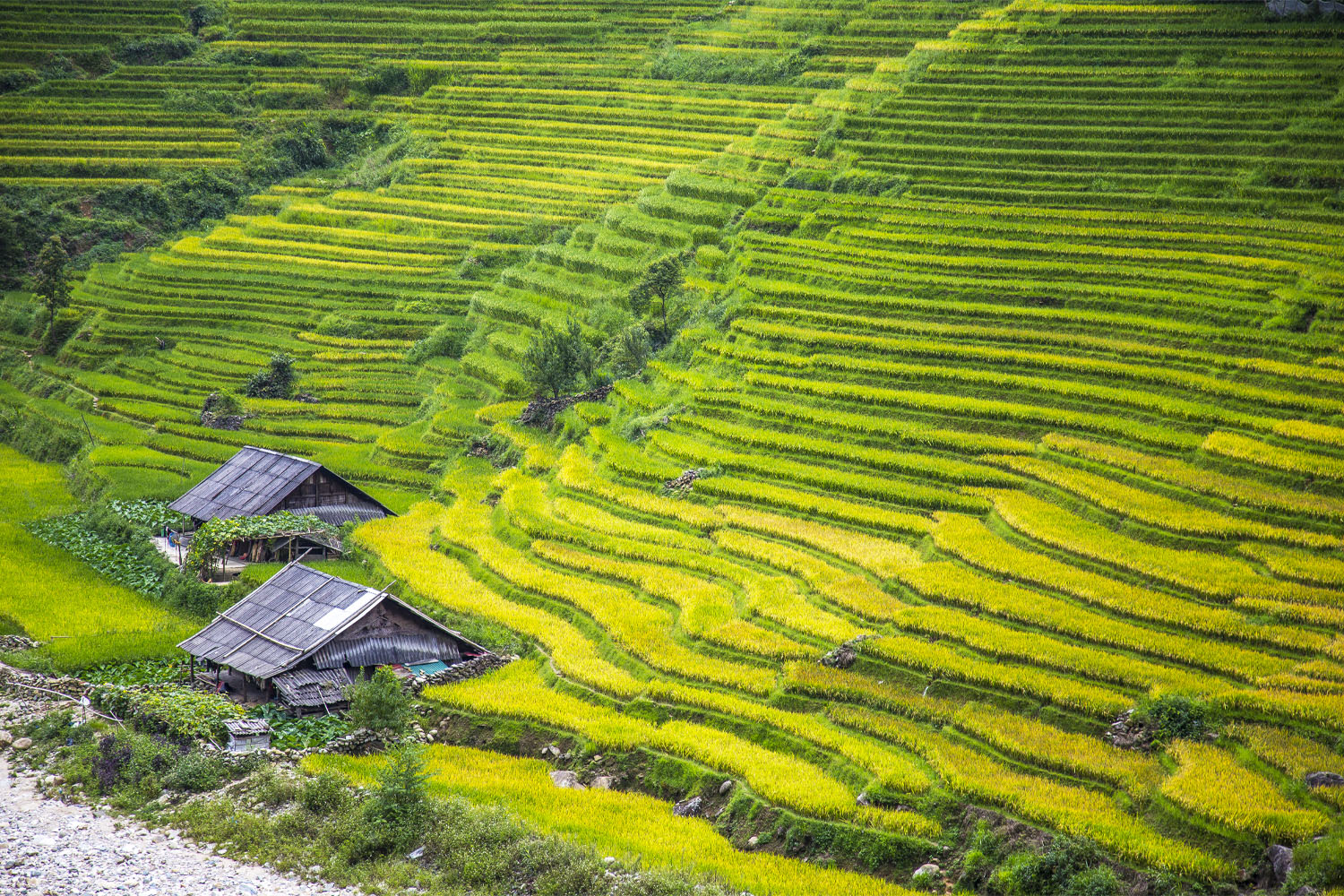
Autumn (September–November): Widely considered the best season in the north. Humidity drops, skies clear, and temperatures settle into a comfortable range. Sa Pa’s rice terraces turn gold in late September and October, drawing trekkers and photographers from around the world.
Winter (December–February): Cold, damp, and often gray, particularly in Ha Noi, where temperatures can drop into the low teens Celsius and a persistent drizzle known locally as “crachin” settles over the city for days at a time. Sa Pa gets considerably colder still, with occasional frost or even light snow at higher elevations.
Central Vietnam: watch the typhoon calendar

Central Vietnam’s weather is shaped by one dominant factor: its exposure to the South China Sea and the typhoons that regularly form there.
Dry season (roughly February–August): Hot, sunny, and increasingly popular with beach travelers as the season progresses, particularly around Da Nang and Hoi An. June through August is the hottest stretch, with temperatures often exceeding 35°C.
Wet and typhoon season (roughly September–January): Central Vietnam’s rainy season overlaps directly with the Pacific typhoon season, and this region takes the brunt of it more than anywhere else in the country. October and November see the heaviest rainfall and the highest typhoon risk, sometimes disrupting flights, closing roads, or affecting entire itineraries with little warning. Hue, sitting slightly further north and more exposed, tends to see even heavier rainfall than Da Nang or Hoi An during this period.
Because of this pattern, central Vietnam is genuinely a different destination depending on when you visit — a reliably sunny beach and old-town experience in the dry season, versus a wetter, moodier visit (still workable, but worth planning around) in the late-year wet season.
Southern Vietnam: wet season, dry season, warm year-round

The south follows the most straightforward pattern of the three regions.
Dry season (roughly December–April): Sunny, hot, and the most popular stretch for travelers heading to Ho Chi Minh City, the Mekong Delta, and Phu Quoc. Humidity is lower and rainfall is minimal, making this the easiest season for boat trips, cycling, and general outdoor sightseeing.
Wet season (roughly May–November): Hot and humid with regular afternoon rain showers, usually brief and intense rather than day-long. Mornings are often clear, making early starts a smart strategy for outdoor activities. Phu Quoc’s wet season, in particular, tends to be quieter and comes with noticeably lower accommodation prices, which some travelers see as a worthwhile trade-off.
Temperatures across the south stay warm throughout the year, generally in the 25–34°C range, so unlike the north, there’s no genuinely cold season to plan around here — only degrees of rain.
Best time to visit Vietnam by trip type

For a single-region trip:
- North (Ha Noi, Ha Long Bay, Sa Pa): September to November for the clearest skies and most comfortable temperatures; March to April as a milder, greener alternative.
- Central (Hue, Da Nang, Hoi An): February to August for reliable beach and sightseeing weather, avoiding the September–January typhoon window.
- South (Ho Chi Minh City, Mekong Delta, Phu Quoc): December to April for the driest, sunniest conditions.
For a full north-to-south itinerary: This is where Vietnam’s regional weather variation actually works in your favor. A trip planned for February through April, for example, catches the north in mild spring conditions, central Vietnam still in its dry season, and the south wrapping up its most comfortable weather window — a genuinely workable overlap across all three regions.
For a purely beach-focused trip: December through April keeps you almost entirely in dry-season conditions whether you’re on Phu Quoc, around Nha Trang, or along the central coast, since this window falls after central Vietnam’s typhoon season has cleared and before its full summer heat sets in.
Understanding Vietnam’s typhoon season
Typhoon season deserves its own callout, since it’s the single biggest weather risk for travelers, and it affects central and northern coastal Vietnam far more than the south. Storms typically form between June and November, with September through November representing the highest-risk window for central Vietnam specifically. A typhoon’s direct path is genuinely unpredictable more than a few days out, so travelers with fixed dates in this window should build some flexibility into their itinerary — refundable bookings where possible, and an awareness that flights or ferries (particularly to Ha Long Bay or Phu Quoc) can be delayed or canceled with fairly short notice during an active storm.
This isn’t a reason to avoid central and northern Vietnam entirely during these months — most days in this window pass without any storm impact at all — but it is a reason to travel with a degree of built-in flexibility rather than a rigid, back-to-back schedule.
Packing around Vietnam’s weather
- Layer for the north in winter. Ha Noi’s damp cold and Sa Pa’s mountain chill both call for a proper jacket, something few travelers expect to need in Vietnam.
- Bring rain protection year-round, everywhere. Even in the driest months, a sudden afternoon shower is always possible. A compact umbrella or light rain jacket earns its space in any Vietnam packing list.
- Prioritize breathable fabrics for the south and center. Humidity, not just heat, is what makes these regions feel intense — lightweight, quick-drying clothing matters more than how hot the actual temperature reads.
- Check the typhoon forecast before booking central Vietnam travel in the September–November window, and build a buffer day or two into multi-stop itineraries during this period.
FAQ

What is the best month to visit Vietnam overall? There’s no single best month for the entire country, since the north, center, and south follow different seasonal patterns. February to April offers the closest thing to a favorable overlap across all three regions.
Is Vietnam hot all year round? The south and, to a lesser extent, the center stay warm to hot year-round. The north has a genuine winter, with Ha Noi and Sa Pa both seeing noticeably cold, damp conditions from December through February.
When is typhoon season in Vietnam? Roughly June through November, with September through November representing the highest-risk window, primarily affecting central and northern coastal areas rather than the south.
Is it worth visiting Vietnam during the wet season? Often, yes. Wet-season rain across most of Vietnam tends to arrive as short, intense afternoon showers rather than all-day downpours, and traveling in these months usually means fewer crowds and lower prices. Central Vietnam’s peak typhoon window (roughly October–November) is the exception worth planning around more carefully.
Does Vietnam’s weather affect flights between regions? Occasionally, particularly during typhoon season, when flights or ferries to and from central and northern coastal destinations (including Ha Long Bay) can face short-notice delays. Southern Vietnam is rarely affected in the same way.
Planning around Vietnam’s climate
Vietnam’s weather is genuinely three different climates layered into one country, and that variation is as much an opportunity as a challenge — a well-timed itinerary can chase good weather from the northern highlands to the southern coast within a single trip. Understanding each region’s pattern before you book is what turns “Vietnam weather” from a source of uncertainty into one of the more useful planning tools available for building the right trip.





