
Deciding between north and south Vietnam is one of the first real planning questions most first-time visitors run into. Ha Noi and Ho Chi Minh City sit roughly 1,650 kilometers apart, and that distance shows up in almost everything: the weather, the pace of life, the food, even the way people talk to strangers. Neither region is the “better” choice. They’re simply different trips.
This guide walks through how the two regions actually compare, so you can figure out which one fits your travel style, or how to fit both into a single itinerary if your schedule allows it.
Weather: four seasons in the north, two in the south

The clearest difference between the two regions is climate, and it’s one that catches a lot of first-time visitors off guard.
Northern Vietnam has a genuine four-season year. Winter, from December through February, brings cool, often damp weather, with temperatures in Ha Noi typically sitting between 15–20°C and dropping colder still in the mountains around Sa Pa, where frost is possible. Spring (March–May) warms up gradually, summer (June–August) turns hot and humid, and autumn (September–November) is widely considered the most pleasant stretch of the year — clear skies, comfortable temperatures, and the golden rice terraces that draw trekkers to Sa Pa each October.
Southern Vietnam runs on a simpler, tropical rhythm: a dry season from roughly December to April and a wet season from May to November, with temperatures staying in the high 20s to low 30s Celsius almost year-round. There’s no real winter here — just degrees of heat and humidity, with occasional sea breezes taking the edge off on islands like Phu Quoc.
What this means for your trip: if you want a four-season experience, cooler mountain air, and the option to time a visit around a specific seasonal landscape, the north has more to offer. If you’d rather pack light and not think about layering at all, the south’s consistency is the easier bet.
Culture and pace of life: traditional north, fast-moving south

Vietnam’s north and south developed along different historical paths, and that history still shapes how each region feels to visit today.
The north carries the weight of being Vietnam’s political and cultural center for roughly a thousand years, with centuries of close contact with China shaping its traditions. Ha Noi’s Old Quarter, its water puppet theaters, and its classical arts scene reflect that depth. Social interactions tend to be a little more formal and reserved, and the overall pace feels measured rather than rushed.
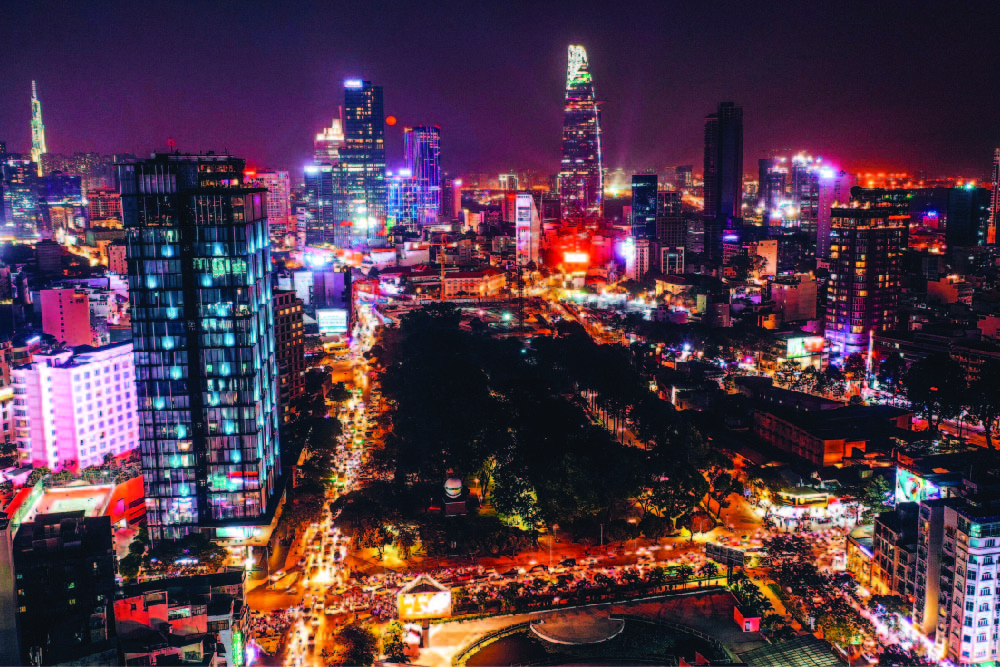
The south came into its own later and absorbed a wider mix of influences — Khmer, Chinese, and French colonial, among others — which shows up in everything from its architecture to its food. Ho Chi Minh City runs on a noticeably faster, more entrepreneurial energy, with directness and spontaneity standing in for the north’s formality.
Neither pace is objectively better. Travelers drawn to history, tradition, and a quieter rhythm tend to connect more with the north. Those who want big-city energy and a more modern, fast-moving atmosphere usually find Ho Chi Minh City more their speed.
Food: subtle in the north, bold in the south
Vietnamese cuisine itself splits fairly clearly along the same north-south line.
Northern cooking leans toward subtlety — clear broths, restrained seasoning, and a focus on letting a few core ingredients speak for themselves. Pho actually originated here, and the northern version stays close to its roots: a clean, simmered broth with minimal garnish. Other northern staples worth seeking out include bun cha (grilled pork with vermicelli), cha ca (turmeric fish), and banh cuon (steamed rice rolls).
Southern cooking turns the volume up — more sugar, more fresh herbs, and bolder, sweeter, sometimes spicier combinations, helped along by a tropical climate that keeps herbs and produce available all year. Southern-style pho typically arrives loaded with bean sprouts, lime, and a plate of fresh herbs for diners to customize. Signature dishes include com tam (broken rice with grilled pork), banh xeo (crispy savory pancakes), and canh chua (sweet and sour soup).
Most travelers end up enjoying both styles rather than picking a side — it’s less a question of which is “better” and more a question of which flavor profile you’re in the mood for on a given night.
What to see: mountains and bays versus beaches and deltas

Northern highlights center on dramatic landscapes and cultural depth:
- Ha Long Bay — the north’s signature attraction, with thousands of limestone karsts rising out of emerald water, usually explored on an overnight cruise
- Ha Noi — the Old Quarter, the Temple of Literature, and a dense concentration of museums and colonial-era architecture
- Sa Pa — rice terrace trekking, ethnic minority villages, and cool mountain air
- Ninh Binh — limestone karst scenery you can explore by boat, within easy reach of Ha Noi
Southern highlights lean toward urban energy, history, and the coast:
- Ho Chi Minh City — the War Remnants Museum, Independence Palace, and Ben Thanh Market, alongside the nearby Cu Chi Tunnels
- Mekong Delta — floating markets, orchards, and boat trips through a dense network of waterways
- Phu Quoc — white-sand beaches and a more laid-back island pace
- Con Dao — a quieter, more remote archipelago for travelers who want to get further off the beaten path
If mountains, karst scenery, and trekking appeal to you most, the north has the edge. If you’re drawn to beaches, river life, and recent history, the south delivers more of what you’re looking for.
Getting around: which region is easier to travel in

Infrastructure differs enough between the two regions that it’s worth factoring into your decision, especially for first-time visitors.
The south, anchored by Ho Chi Minh City, generally has more developed tourist infrastructure, a wider range of accommodation and dining, and somewhat more consistent English proficiency in tourist areas. That tends to make it a slightly more comfortable starting point for travelers who want things to run smoothly with minimal friction.
The north is well set up around Ha Noi and Ha Long Bay, with professional tour operators and reliable transport links between major stops, but rural areas and smaller towns can feel noticeably less developed once you’re off the main circuit. For many travelers, that’s part of the appeal — it tends to translate into a more traditional, less commercialized experience. For others expecting modern conveniences everywhere, it can take some adjustment.
Neither region will leave you stranded; both are well within reach of organized tours, domestic flights, and reasonably comfortable transport. The difference is more about polish than access.
Cost: both regions are affordable, with minor differences
Budget rarely decides this choice on its own, since both regions are inexpensive by international standards, but there are small differences worth noting.
Northern Vietnam tends to run marginally cheaper outside Ha Noi’s main tourist zones. Street food typically costs $1–3, sit-down meals $5–15, and budget travelers can get by comfortably on roughly $30–50 a day. Ha Long Bay cruises vary widely, from around $50 for a basic overnight junk boat to $300 or more for a luxury version.
Southern Vietnam runs slightly higher, particularly around Ho Chi Minh City’s tourist core and resort areas like Phu Quoc, though the gap is modest. Comfortable budget travel generally falls in the $30–60 a day range, with Mekong Delta day trips from Ho Chi Minh City typically priced between $30 and $50.
In practice, the cost difference is small enough that it shouldn’t be the deciding factor between the two regions — your interests and the time you have available matter far more.
Choosing north, south, or both

Choose the north if you want: a four-season climate, cooler weather options, dramatic mountain and karst scenery, deeper historical and cultural immersion, subtle and refined cuisine, and a generally less commercialized travel experience.
Choose the south if you want: warm weather year-round, easy beach and island access, a faster, more modern urban energy, bold and herb-heavy cuisine, recent-history sites, and a slightly smoother travel experience overall.
If you have two to three weeks, you don’t have to choose at all. A north-to-south itinerary — typically a week in the north around Ha Noi and Ha Long Bay, a few days in central Vietnam (Hoi An or Hue), and a week in the south covering Ho Chi Minh City plus the Mekong Delta or a beach stop — gives you a genuine cross-section of the country rather than a partial picture.
Getting between the two regions
For travelers combining both, Vietnam offers a few practical ways to cover the distance:
- Flying is the fastest option, at roughly two hours between Ha Noi and Ho Chi Minh City, with fares commonly ranging from $30–100 depending on the airline and how far ahead you book. This is the practical choice for most itineraries with limited time.
- The Reunification Express train covers the same route in around 30 hours, passing through scenic stretches of the central coast. It suits travelers with flexible schedules who want the overland experience rather than speed.
- Overland buses are the cheapest option but take the longest, usually broken into multiple stops through central Vietnam. They work best for budget travelers who want to see the country in stages rather than cover it quickly.
FAQ

Is north Vietnam or south Vietnam better for first-time visitors? Neither is objectively better — it depends on what you’re drawn to. First-timers with limited time often choose based on their priorities: the north for mountains, culture, and Ha Long Bay; the south for beaches, city energy, and easier logistics.
Can I visit both north and south Vietnam in one trip? Yes, and many travelers do. A trip of two to three weeks comfortably allows a north-to-south route connecting both regions through central Vietnam.
Which region has better weather for a short trip? It depends entirely on when you’re traveling. The south’s tropical climate stays warm year-round, while the north has real seasonal variation — autumn (September–November) and spring (March–May) are generally the most comfortable windows up north.
Is food very different between north and south Vietnam? Yes. Northern cuisine tends to be more subtle and restrained, while southern cuisine is bolder, sweeter, and more herb-forward. Many travelers enjoy sampling both styles rather than preferring one outright.
Is it cheaper to travel in north or south Vietnam? Both regions are affordable by international standards, with the north running marginally cheaper outside major tourist zones. The difference is small enough that it shouldn’t be the main factor in your decision.
There’s no wrong answer
North and south Vietnam offer genuinely different trips rather than better or worse versions of the same one. The north rewards travelers drawn to tradition, mountain scenery, and a four-season climate; the south suits those after warmth, coastline, and city energy. If your schedule allows it, seeing both is the fullest way to understand what makes Vietnam worth visiting in the first place — but either region on its own makes for a complete, memorable trip.





