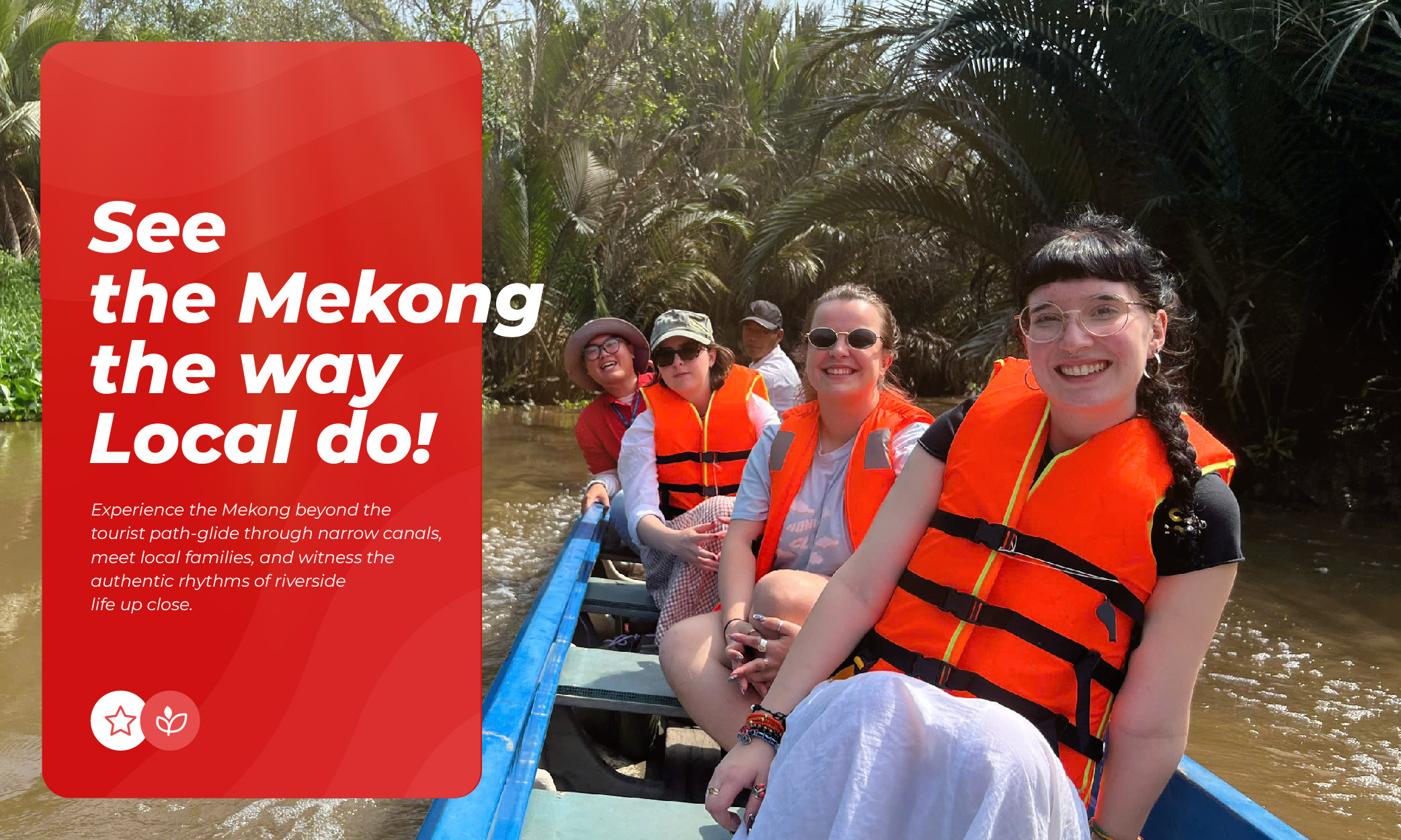
Overview
Three days through the heart of the Mekong Delta — from the speed boat pier at Châu Đốc all the way to Ho Chi Minh City, stopping at the places most tours skip.
Most travellers moving between Cambodia and Ho Chi Minh City take the speed boat to Châu Đốc and head straight south. This tour turns that transit into a proper journey. Your guide meets you at the Châu Đốc pier the moment the speed boat docks, and from there the trip moves at the pace of the delta — through the An Giang border province, the Khmer-influenced cooking and temples of the far southwest, the great cajuput forest of Trà Sư, the working island of Cù Lao Ông Hổ in Long Xuyên, the early-morning wholesale markets of Cần Thơ, and the extraordinary flower village and old colonial houses of Sà Đéc.
This is a cultural immersion tour, not a highlights checklist. The focus is on food, local craft, river life, and the Buddhist and Khmer heritage that gives this part of the delta its particular character. If you get up early on Day 3, you can experience two of the most famous floating markets in southern Vietnam before 8 AM. If you’d rather sleep in, the rest of the day is full.
The tour runs as a private trip for your group: the vehicle, guide, and all boat activities are exclusively for you. 3-star local standard hotels at each overnight stop. Meals cover the dinners and lunches where local food is the point; breakfasts are at the hotel.
Why this tour
• Straight off the Phnom Penh speed boat: your guide meets you at the Châu Đốc pier. You don’t navigate an unfamiliar border town alone. The tour starts the moment you arrive.
• Trà Sư — the one sight in An Giang you shouldn’t miss: a flooded cajuput forest that most Mekong Delta tours don’t reach. During flood season (October–November) the water rises to the tree trunks and the lotus flowers bloom across the surface. Even in the dry season it’s one of the most distinctive landscapes in the delta.
• Two floating markets, both genuine: Cài Bè on Day 1 route and Cài Răng on Day 3 morning are the largest wholesale floating markets in the delta. If you get up early on Day 3, you can have breakfast on the water and watch the city’s fruit and vegetable supply change hands before dawn.
• Local food at the right place: bún cá Châu Đốc in Châu Đốc, búnmăm in Cần Thơ, hủ tiếu in Sà Đéc. Each stop has a dish that belongs to it. The guide knows where locals actually eat.
• Private all three days: vehicle, guide, and activities are exclusively for your group.
Tour highlights
• Trà Sư cajuput forest (Day 1): an 850-hectare protected wetland in An Giang. Motorboat on the main channel, then a rowboat into the narrower waterways under the cajuput canopy. Storks, herons, egrets, and bats. At flood season, the forest floor disappears under water and the trees grow straight from the surface.
• Miếu Bà Châu Đốc — evening temple visit (Day 1): the Lady of the Realm temple at the base of Sam Mountain is one of the most visited pilgrimage sites in southern Vietnam. The atmosphere is completely different at night — incense smoke, candlelight, and pilgrims from across the delta.
• Nước thốt nốt — palm sugar juice (Day 1): the drink that belongs to the Châu Đốc border region. Cold, slightly sweet, slightly fermented, extracted from the toddy palm flower. Hard to find outside An Giang province.
• Cù Lao Ông Hổ island, Long Xuyên (Day 2): a quiet river island in the Bassac River, birthplace of President Tôn Đức Thắng. The island is almost entirely untouristed. Cycling the lanes past traditional wooden houses, fruit orchards, and the families who make incense sticks (nhàng) by hand on their front porches.
• Cài Răng floating market, Cần Thơ (Day 3 early morning): the largest wholesale floating market in the Mekong Delta, at its peak between 5:30 and 8:00 AM. Hundreds of boats trading produce on the Cần Thơ River. Breakfast from the food boats — beef noodle soup and iced coffee on the water. Early risers only, but genuinely worth it.
• Hủ tiếu lò (noodle factory), Sa Đéc (Day 3): the Sà Đéc-style rice noodle is made differently from the Saigon version: thinner, smoother, and dried on bamboo racks in the sun. The family noodle workshops in Sà Đéc are still the source for much of the delta’s supply.
• Huỳnh Thủy Lê ancient house, Sa Đéc (Day 3): the ancestral home of the Vietnamese-Chinese merchant who appears in Marguerite Duras’s novel ‘The Lover’. A well-preserved late 19th-century southern Chinese merchant house with French colonial additions. The house is the reason many Western travellers stop in Sà Đéc at all.
• Sa Đéc flower village (Day 3): one of the main flower-growing centres for the Tết New Year market. The growing fields are in bloom year-round but reach their peak in December and January, when hundreds of varieties are being prepared for the Lunar New Year.
When to go
The tour runs year-round, but the experience is significantly different depending on the season. Here’s what to expect:
| Season | When | Why it matters |
| Flood season (best) |
• October to November |
– Trà Sư Forest is fully flooded — the cajuput trees rise straight from the water and the lotus fields are in bloom. The most photogenic and atmospheric time of year. Water levels are highest; the rowboat goes deeper into the forest. |
|
Pre-Tết (very good) |
• December to January |
– The Sà Đéc flower village is at its peak: hundreds of varieties grown specifically for the Tết New Year market. The most colourful time to visit. Comfortable dry-season temperatures. |
| Dry season |
• February to April |
– Pleasant weather, low humidity, easy travel. Trà Sư has less water but the forest is still beautiful. Cài Răng market is active year-round. |
| Avoid | • Tết week (late Jan / Feb) | – Many local businesses and restaurants close. Cài Răng market is quieter. Roads are busy. Not recommended. |
Flood season (mùa nước nổi) — October to November
The Mekong flood season is when the river system at its most visually dramatic. Water from the Himalayas via the Mekong takes months to arrive in the delta — it peaks in October and November. Trà Sư Forest is fully inundated: the cajuput trees rise from still, dark water covered in lotus flowers and duckweed. The fields between the roads become shallow lakes. Fishing is active everywhere. This is the most photogenic and atmospherically distinctive time to travel through An Giang.
Pre-Tết flower season — December to January
Sà Đéc is one of the main suppliers of flowers for the Tết New Year festival. In December and January the growing fields are at their most colourful: marigolds, chrysanthemums, and dozens of other varieties fill the plots between the river and the road. The dry-season weather is comfortable, the delta is cool in the mornings, and the flower village is at its absolute peak. This is the best time to combine the Sà Đéc stop with the wider tour.
Local food by stop
Each town on this route has dishes that belong to it. The guide knows where locals eat and will take you there — not to tourist restaurants. Below is what to look for at each stop.
| Location | Must-try dish | What it is |
| Châu Đốc (Day 1) | Bún cá Châu Đốc | Rice vermicelli soup with freshwater fish and turmeric broth — the dish this town is famous for across Vietnam. |
| Châu Đốc (Day 1) | Nước thốt nốt | Palm sugar juice from the toddy palm, served cold. Slightly sweet, slightly fermented, and only found near the Cambodian border. |
| Châu Đốc (Day 1) | Mắm châu đốc | Fermented fish paste from the Bassac River — pungent, intensely flavoured, eaten as a condiment with rice and vegetables. |
| Long Xuyên (Day 2) | Bún nước lèo | Khmer-influenced rice noodle soup with pork and prawn, served with bean sprouts and herbs. |
| Cần Thơ (Day 2) | Bún mắm | Fermented fish noodle soup — a strong, complex broth with pork belly, prawn, and a generous tangle of fresh herbs. A delta staple. |
| Sà Đéc / en route (Day 3) | Hủ tiếu Sa Đéc | Dry or soup rice noodles with pork, made with Sà Đéc’s own noodle variety, thinner and smoother than the Saigon version. |
| Cài Răng (Day 3) | Bún bò / cà phê | Breakfast on the water at the floating market: beef noodle soup and Vietnamese iced coffee from the food boats. |
⚠️ Food allergies and dietary requirements
Delta Vietnamese cooking makes extensive use of freshwater fish, fermented fish paste (mắm), shrimp paste, peanuts, and shellfish. Many dishes that appear vegetarian contain fish sauce or dried shrimp as a base ingredient.
Please notify TNK of any allergies or dietary requirements at booking — not on the day of departure. This applies to: fish/shellfish allergies, nut allergies, gluten intolerance, strict vegetarian or vegan requirements, halal requirements, and any other food-related medical conditions. The guide will work with each restaurant in advance. We cannot guarantee allergy-safe kitchens at floating market food boats.
Important information
Arrival from Phnom Penh — what happens at the pier
• Your guide meets you at the Châu Đốc International Floating Port (Victoria Châu Đốc Hotel pier, 01 Lê Lợi Street) as you disembark from the speed boat.
• The speed boat from Phnom Penh arrives at approximately 06:30 PM. If your speed boat is delayed, the guide waits.
• The guide holds a sign with your name or “TNK Travel”. If you cannot locate the guide on arrival, call the TNK hotline: +84 938 195 445.
• Speed boat ticket from Phnom Penh to Châu Đốc is NOT included in this tour. Book separately. The Hàng Châu speed boat departs Phnom Penh at 12:00 PM, arrives Châu Đốc ~06:30 PM. Cambodia Visa on Arrival ($37 USD) applies on the reverse route — not applicable for this direction (Vietnam entry).
• Vietnam E-visa: ensure it is valid for entry. If you entered Cambodia by air and hold a Vietnam E-visa, check that it has remaining entries. The guide can assist with any entry questions on arrival.
Accommodation
• Night 1: hotel in Châu Đốc, 3-star local standard. Typically near the Bassac River waterfront. Room: double or twin, private bathroom, air conditioning, Wi-Fi.
• Night 2: hotel in Cần Thơ, 3-star local standard. Typically near the Ninh Kiều waterfront. Room: double or twin, private bathroom, air conditioning, Wi-Fi.
• Single supplement: $30 USD per night. Applies to guests occupying a room alone.
• Room preferences (double vs twin, low floor, river view) can be requested but are not guaranteed by hotel availability.
Cái Răng early morning option — Day 3
Early risers: wake-up call at 5:00 AM
Cái Răng Floating Market peaks between 5:30 and 8:00 AM. The guide can arrange an early morning boat departure from the Ninh Kiều waterfront at around 5:30 AM, arriving at the market at peak trading time for breakfast on the water before the main programme starts. This is optional and requires a 5:00 AM wake-up. Let TNK know at booking if your group wants to do this — the hotel will arrange an early breakfast box or you eat at the market. The rest of Day 3 starts approximately 30 minutes later than the standard schedule.
Physical requirements
• Moderate activity level across all three days. Getting in and out of boats is the main physical challenge — the motorboat at Trà Sư has a step down; the rowboat sits low on the water. The guide assists at each boarding point.
• Day 2 island cycling: flat lanes on Cù Lao Ông Hổ — suitable for all fitness levels. Walking is equally good if anyone prefers not to cycle. Let the guide know at the start of the island stop.
• Cài Răng floating market (early morning option): the motorboat on the Cần Thơ River is covered. The market is observed from the boat — no climbing or walking required.
• Not recommended for guests with serious mobility limitations.
What to wear and bring (3 days)
• Light clothing for three days. The delta is warm and humid. Pack for overnight stays.
• Comfortable closed-toe shoes or sandals with straps for boat boarding and island walking
• Modest dress for temple visits (Day 1 Miếu Bà): shoulders and knees covered
• Insect repellent — essential for Trà Sư and the island
• Hat and sunscreen for river and open-field sections
• Light rain layer — wet season brings afternoon showers
• Camera with zoom for bird spotting at Trà Sư
Cash (USD or VND) for tips, personal purchases, and optional extras\
Related tours
• Mekong Delta 3 days 2 nights — Cai Be, Can Tho & Chau Doc (MK3): the reverse direction, HCMC to Chau Doc with Cambodia speed boat option
• Mekong Delta luxury small group day tour (LX-MK1): My Tho & Ben Tre full day from Ho Chi Minh City, max 7 guests
• Can Gio Mangrove Forest day tour (PGT-CGB): half day speedboat to the UNESCO mangrove biosphere reserve
Itinerary
Day 1 — Arrive Châu Đốc → Dinner → Miếu Bà Chúa Xứ Núi Sam & palm juice | Meal: dinner
Your guide meets you at the Victoria Châu Đốc Hotel pier as you step off the Phnom Penh speed boat. The boat arrives at approximately 6:30 PM. After collecting luggage and a brief introduction, the vehicle heads to the hotel for check-in and a quick freshen-up. Châu Đốc is the westernmost city in the delta — a border trading hub with a strong Khmer and Cham Muslim presence that gives it a different character from the rest of the Mekong Delta. The guide gives an overview of the three days ahead.
7:30 PM Dinner — bún cá Châu Đốc
Dinner at a local restaurant in Châu Đốc. The signature dish of this town is bún cá Châu Đốc — a rice vermicelli soup with freshwater fish (typically snakehead or catfish) in a turmeric-laced broth, served with fresh herbs, bean sprouts, and a side of fermented fish paste (mắm). Every family’s version is slightly different. The guide picks the restaurant where locals go, not the tourist street. Other local dishes worth trying: bò núi Sam (beef from the Sam Mountain area), càri cá (delta-style fish curry with coconut milk). Vegetarian options available — advise at booking.
8:30 PM Miếu Bà Châu Đốc — evening temple visit & palm juice
The Lady of the Realm Temple (Miếu Bà Chúa Xứ) at the base of Sam Mountain is one of the most important pilgrimage sites in southern Vietnam, drawing hundreds of thousands of visitors each year for the annual Ba Chua Xu Festival (April by lunar calendar). At night, the temple takes on a different atmosphere from the daytime tourist visit: incense smoke drifts across the entrance, candles illuminate the inner shrine, and local pilgrims — many of them from the delta towns and Cambodian border communities — come to pray and make offerings. The guide explains the Lady of the Realm tradition, her origin story, and the temple’s significance across both Vietnamese and Khmer communities in the region.
After the temple, the group tries nước thốt nốt — cold palm sugar juice extracted from the toddy palm flower, sold from carts near the temple entrance. Slightly sweet, slightly fermented, with a gentle earthiness that is completely unlike any other drink in Vietnam. This juice is essentially unavailable outside An Giang province.
Day 2 — Trà Sư Forest → Long Xuyên → Cù Lao Ông Hổ island → Cần Thơ | Meals: breakfast, lunch
Early breakfast at the hotel. Checkout. The vehicle heads south to Trà Sư Forest in Tịnh Biên district, approximately 25 kilometres, about 30 minutes. An early start means arriving before the midday heat and before day-trip groups from Châu Đốc.
7:15 AM Trà Sư cajuput forest
The visit begins with a motorised flat-bottomed boat on the main canal — the water surface often covered in duckweed and water hyacinth, vivid green against the papery white cajuput trunks. After 15 minutes the boat transitions to a rowboat for the narrower waterways deeper inside the forest. The canopy closes overhead and the sounds reduce to the paddle, the birds, and the water.
In the flood season (October–November), the forest floor is completely submerged and the trees appear to rise straight from still, dark water. Lotus flowers bloom across the flooded sections. Bird species commonly sighted: little egrets, purple herons, Asian openbill storks, and various cormorant species. Bats roost in large numbers in the canopy. An observation tower near the jetty gives a view over the treetops. Approximately 1.5 hours at the forest.
Trà Sư is not on the standard Mekong Delta circuit. Most people heading from Châu Đốc to Cần Thơ bypass it entirely. The guide explains why An Giang has a different character from the rest of the delta: the Khmer Krom population, the Cham Muslim communities along the Bassac River, and the border economy that has shaped this province for centuries.
9:00 AM Drive to Long Xuyên
The vehicle heads northeast to Long Xuyên, approximately 60 kilometres, about 1 hour. Long Xuyên is the provincial capital of An Giang. The guide introduces Cù Lao Ông Hổ island during the drive.
10:15 AM Cù Lao Ông Hổ island — Long Xuyên
A short boat crossing from the Long Xuyên waterfront to Cù Lao Ông Hổ (Tiger Man Island) — a river island in the Bassac River known as the birthplace of Tôn Đức Thắng, the second President of unified Vietnam. The island is almost entirely unvisited by tourists — there are no signs, no souvenir shops, and no fixed programme. That’s the point.
The guide leads the group on a cycling loop through the island’s lanes. What you see on the way: • Traditional southern Vietnamese wooden houses — long, narrow, dark inside, with ancestor altars and French-tiled floors • Fruit orchards: longan, sapodilla, and jackfruit trees shading the paths (Depending on the season, there will be different kinds of fruit.) • Incense stick workshops (làng nghề làm nhàng) — family operations making nhàng (incense sticks) by hand on their front porches. The sticks are bundled and dried in the sun. The smell of the drying incense drifts across the entire lane. • The Tôn Đức Thắng Museum — a small memorial to the island’s most famous son, with personal effects, photographs, and documents. Worth 20 minutes.
Walking alternative available if anyone prefers not to cycle. The guide arranges accordingly. Approximately 1.5–2 hours on the island.
12:00 PM Lunch — Long Xuyên
Lunch at a local restaurant in Long Xuyên before the afternoon drive. Long Xuyên’s local specialties include bún nước lèo (a Khmer-influenced rice noodle soup with pork and prawn) and various freshwater fish dishes from the Bassac River. The guide picks the restaurant. Vegetarian options available — advise at booking.
1:30 PM Drive to Cần Thơ
The vehicle continues southwest to Cần Thơ, approximately 70 kilometres, about 1.5 hours. Cần Thơ is the largest city in the Mekong Delta and the base for tomorrow’s early morning market visit. The guide introduces Cài Răng Floating Market, the Cần Thơ river, and what to expect in the morning if the group opts for the early departure.
3:00 PM Check-in — Cần Thơ hotel
Check-in at the Cần Thơ hotel near the Ninh Kiều waterfront. Afternoon free: walk along the Ninh Kiều promenade, visit the market, or rest at the hotel. The guide is available for restaurant recommendations for the evening dinner (dinner on Day 2 is on your own account; budget approximately $8–15 USD per person for a good riverside meal). Cần Thơ specialties to try: búnmăm (ferm
Day 3 — Cái Răng market → Sà Đéc → Ho Chi Minh City | Meals: breakfast, lunch
Optional: early start for guests who want the floating market at peak.
Motorboat from Ninh Kiều pier at 5:30 AM. Cài Răng is at full trading activity between 6:00 and 8:00 AM — hundreds of wholesale boats on the Cần Thơ River, the ‘hanging tree’ tradition identifying each vessel’s cargo, food boats selling bún bò and cà phê to the traders. This is breakfast on the water. By 9:00 AM the market begins to thin. Confirm with TNK at booking if your group wants the early option.
7:30–8:00 AM Hotel breakfast & checkout — Cần Thơ
Hotel breakfast and checkout. Groups who did the early market option will have already eaten on the water; hotel breakfast can be skipped or taken lightly.
9:00 AM Drive to Sà Đéc
The vehicle drives northeast along the delta highway toward Sà Đéc, approximately 85 kilometres, about 1.5 hours. The route crosses several river channels by bridge, giving good views of the delta waterway system. The guide introduces Sà Đéc: the noodle industry, the flower village, and the Hương family house that became the setting for Marguerite Duras’s 1984 novel ‘The Lover’.
10:30 AM Hủ tiếu factory — Sà Đéc noodle workshop
Sà Đéc has been the centre of rice noodle production in the Mekong Delta for over a century. The local variety — hủ tiếu Sà Đéc — is thinner and smoother than the Saigon version, made from a different rice flour mix and dried on bamboo racks laid out in the open air. A family workshop visit: the rice soaked overnight, milled, pressed through moulds, and laid flat on the bamboo frames to dry in the sun. The volume produced by a single family operation is surprisingly large. The guide explains the distribution network: most of the noodles end up in soup kitchens across Cần Thơ, Long Xuyên, and Ho Chi Minh City.
11:15 AM Huỳnh Thủy Lê ancient house
The most visited colonial-era building in Sà Đéc. Built in 1895 by a Vietnamese-Chinese merchant family, the Huỳnh house is a two-storey structure that combines a southern Chinese merchant house layout — long, narrow, deep, with an interior courtyard — with French colonial facade elements: arched windows, decorative cornices, and ornate plasterwork. The interior has been preserved with original furniture, carved wooden screens, and family portraits.
The house’s fame in the Western world comes from Marguerite Duras’s novel ‘The Lover’ (L’Amant, 1984), which fictionalises the relationship between a French schoolgirl and Huỳnh Thủy Lê, the son of the house, in 1920s Indochina. The guide explains both the architectural history and the Duras connection. Approximately 30 minutes.
12:00 PM Sà Đéc flower village
A short drive to the flower growing fields on the edge of Sà Đéc. The village is one of the main suppliers of ornamental flowers for the Tết New Year market, particularly for Ho Chi Minh City. Hundreds of varieties are grown in plots between the river and the provincial road — marigolds (cúc vạn thọ), chrysanthemums (cúc đồng tiền), cock’s comb (mào gà), and various orchid species. In December and January, the fields are at their most colourful as the plants are brought to full bloom for the market. The guide explains the growing cycle and the supply chain to the Lunar New Year.
1:00 PM Lunch — Sa Đéc or en route
Lunch at a local restaurant. Sà Đéc is known for hủ tiếu — the local rice noodle dish served either in soup or dry, with pork, prawn, and a scattering of fried shallots. The guide recommends where to eat. Vegetarian options available — advise at booking.
2:00 PM Drive to Ho Chi Minh City
The vehicle departs Sà Đéc for Ho Chi Minh City via the Cao Lãnh Bridge and Highway 80–60. The drive is approximately 2–2.5 hours depending on traffic. The guide is available for questions on the return journey. Cold water in the vehicle.
4:30–5:00 PM Hotel drop-off — Ho Chi Minh City, District 1. End of tour.
Price & Bookings
All rates are per person in USD. Private tour — vehicle, guide, and all activities exclusively for your group. 2 nights accommodation (3-star local standard), dinners Day 1 & 2, lunches Day 2 & 3 included.
| Tour type | 2 pax | 3–4 pax | 5–7 pax | Holiday 2 pax | Holiday 3–7 pax | Single supp. |
| 3D/2N private tour |
Single supplement applies per night to guests occupying a room alone. 2 nights = 2 × single supplement rate.
Public holidays — holiday pricing applies
If any day of your departure falls on or within the periods below, the holiday surcharge applies.
| Holiday | Dates |
| New Year’s Day | 1 January 2027 |
| Lunar New Year (Tết) | 15 February – 3 March 2026 |
| Hung Kings’ Festival | 26 April 2026 |
| Reunification Day & Labour Day | 30 April – 1 May 2026 |
| Vietnam National Day | 1–2 September 2026 |
Children’s pricing
| Age | Rate | Conditions |
| Under 4 years | Free | Shares bed with parents. No extra bed. |
| 4–10 years | 75% of adult rate | Shares room with min. 2 paying adults. |
| 11 and above | Adult rate | Own bed required. |
What’s included
- Premium vehicle and professional licensed driver for all 3 days
- Professional English-speaking guide for all 3 days
- 2 nights accommodation — 3-star local standard (Châu Đốc + Cần Thơ)
- All boat trips: Trà Sư Forest (motorboat + rowboat), Cù Lao Ông Hổ river crossing, Cài Răng floating market (early morning option)
- Bicycles for Cù Lao Ông Hổ island (or walking alternative)
- All entrance fees: Trà Sư, Tôn Đức Thắng Museum, Huỳnh Thủy Lê ancient house, hủ tiếu workshop, flower village
- Dinners: Day 1 (bún cá + evening temple programme) and Day 2 (NOT included — own account)
- Lunches: Day 2 (Long Xuyên) and Day 3 (Sà Đéc)
- Hotel breakfasts: Day 2 and Day 3
- Nước thốt nốt (palm juice) tasting, Day 1 evening
- Cold water in the vehicle throughout
- All taxes and service charges
What’s not included
- Speed boat ticket Phnom Penh → Châu Đốc (booked separately, approx. $37 USD including Cambodia border fee)
- Day 2 dinner in Cần Thơ (own account, approx. $8–15 USD per person)
- Travel insurance (strongly recommended for a 3-day trip)
- Tips for guide, driver, and boat crews (see tipping kitty section)
- Personal purchases
- Optional shooting range or any other paid extras not listed above
Why TNK Travel
TNK Travel is a Vietnam-based inbound tour operator licensed since 2000. We run daily departures from Ho Chi Minh City and have taken over 1,000,000 travellers on tours across Vietnam, Cambodia, and Laos.
- Ranked #3 on TripAdvisor among Ho Chi Minh City tour operators
- 24,000+ verified reviews across TripAdvisor, Viator, and Klook
- Viator Top-Rated Operator badge
- 94% of travellers recommend our tours
- Licensed operator: International Tour Operator Licence No. 79-102/2010/TCDL-GP LHQT
Frequently asked questions
Do I need to book the Phnom Penh speed boat separately?
Yes. The speed boat from Phnom Penh to Châu Đốc is operated by Hàng Châu and is not included in this tour price. It departs Phnom Penh International Floating Port (103 Sisowath Quay) at 12:30 PM and arrives Châu Đốc at approximately 6:30 PM — check the current schedule with Hàng Châu as times vary by season. Book your speed boat first, then book this tour to match the arrival time.
What is Trà Sư Forest and why is it worth a stop?
Trà Sư (rừng Trà Sư) is a protected wetland forest of 850 hectares in Tịnh Biên district, An Giang province, about 25 kilometres south of Châu Đốc. The dominant tree is the cajuput (Melaleuca cajuputi) — a papery-barked tree that thrives in permanently flooded conditions. During the annual flood season (October–November), the forest floor is completely submerged and the trees appear to grow directly from the water surface. Lotus flowers bloom across the flooded sections. It is one of the most photographed landscapes in the Mekong Delta and one of the least visited by standard tour groups, because reaching it requires coming to Châu Đốc — which most tours skip.
Can I see both Cai Be and Cai Rang floating markets on this tour?
Cài Bè market is in Tiền Giang province and operates in the early morning. This tour’s Day 1 route from Châu Đốc goes directly to Trà Sư in the afternoon — Cài Bè is not on the Day 1 route. Cài Răng, in Cần Thơ, is included as the early morning option on Day 3. If you want to see Cài Bè as well, it can be added as an early stop on Day 2 between Long Xuyên and Cần Thơ — this requires a very early start and adds roughly 1.5 hours to Day 2. Let TNK know at booking and we’ll adjust the schedule.
What is Cù Lao Ông Hổ island?
Cù Lao Ông Hổ (Tiger Man Island) is a river island in the Bassac River opposite Long Xuyên city. It is the birthplace of Tôn Đức Thắng (1888–1980), a labour organiser, revolutionary, and the second President of the Socialist Republic of Vietnam after Ho Chi Minh. The island is largely untouristed and preserves a version of traditional delta life that is increasingly hard to find elsewhere: wooden houses built on stilts, fruit orchards, and cottage industries including hand-made incense sticks. The cycling loop is flat and quiet. The small museum dedicated to Tôn Đức Thắng is worth 20 minutes for historical context, even for travellers who don’t know his name before arriving.
What is the Huynh Thuy Le house and who was the Lover?
The Huỳnh Thủy Lê house in Sà Đéc is a well-preserved late 19th-century merchant house that became internationally known as the setting of Marguerite Duras’s autobiographical novel ‘The Lover’ (L’Amant), published in France in 1984 and winner of the Prix Goncourt. The novel describes Duras’s relationship as a 15-year-old French schoolgirl with Huỳnh Thủy Lê, the son of the house’s wealthy Vietnamese-Chinese owner, in 1929–30 colonial Indochina. The book was later adapted into a film by Jean-Jacques Annaud (1992). The house itself is architecturally interesting independent of the literary connection — a southern Chinese merchant house plan with French colonial additions, fully preserved with original furniture.
Is this tour suitable for older or less active travellers?
Yes, with some caveats. The main physical elements are: getting in and out of boats (the guide assists at each point), the cycling loop on Cù Lao Ông Hổ (walking is an equally good alternative), and the early morning Cài Răng option (entirely optional). The rest of the programme involves walking at a moderate pace through sites that are generally accessible. If anyone in the group has specific mobility concerns, let TNK know at booking and the guide can plan assistance at the boat boarding points.
Tipping kitty — suggested amounts
Tipping is not mandatory but is a meaningful part of income for guides, drivers, and boat operators in the delta. The suggested amounts below are per group, not per person. Collecting into a shared kitty at the start of the tour is the easiest way to manage it.
| Role | Per day | 3 days | Notes |
| Tour guide | $5 USD | $15 USD | Per group per day |
| Driver | $3 USD | $9 USD | Per group per day |
| Boat operators | $2 USD | — | Per group per outing (Trà Sư, Cù Lao, Cài Răng) |
| Restaurant staff | $1–2 USD | — | Per meal, if service is good |
| Hotel porters | $1 USD | — | Per bag, optional |
Suggested total per group (3 days, excluding boat tips & restaurants)
Guide: $45 USD + Driver: $27 USD = $72 USD total for a group of 2–4. Add $10–15 USD per additional couple above 4 pax. For boat operators: keep small USD or VND notes ready — $2–5 USD per boat trip is appropriate.
Book this tour
Private 3-day tour from the Châu Đốc speed boat pier to Ho Chi Minh City. Your guide meets you on arrival. Trà Sư Forest, Cù Lao Ông Hổ, Cài Răng market, Huỳnh Thủy Lê house, Sà Đéc flower village. Local food at every stop. 2 nights 3-star hotels included.
- Online: tnktravel.com — booking form on this page
- WhatsApp: +84 938 195 445
- Email: booking@tnktravel.com
- Walk in: 90 Bui Vien Street, District 1, Ho Chi Minh City
International Tour Operator Licence No: 79-102/2010/TCDL-GP LHQT
Reservations
Reviews
Share your thoughts with other customers.